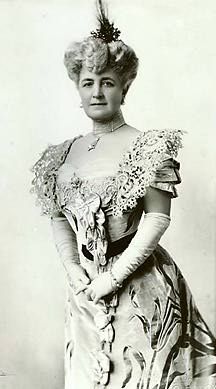
 Bertha Honoré Palmer (May 22, 1849 – May 5, 1918) was one of the most prominent American socialites, businesswomen, art collectors, and philanthropists of the Gilded Age.
Queer Places:
Graceland Cemetery, 4001 N. Clark Street, Chicago, Illinois 60613 United States
Bertha Honoré Palmer (May 22, 1849 – May 5, 1918) was one of the most prominent American socialites, businesswomen, art collectors, and philanthropists of the Gilded Age.
Born in Louisville, Kentucky, into a wealthy family of French descent, she moved with her family to Chicago in 1855.
In 1870, at age 21, she married Potter Palmer, a 44-year-old Chicago real estate magnate, dry-goods merchant, and developer of the famous Palmer House Hotel.
Following the Great Chicago Fire of 1871, the Palmers helped rebuild the city. Bertha joined the Chicago Woman's Club, advocating for working-class women, child labor reform, and healthcare access.
Palmer was appointed President of the Board of Lady Managers for the 1893 World’s Columbian Exposition in Chicago. She oversaw the design, curation, and operation of the Woman’s Building, a pavilion dedicated to celebrating female achievement globally in science, art, and industry.
Assisted by curator Sara Tyson Hallowell, Palmer built an unprecedented collection of French Impressionist art—purchasing works by Claude Monet, Edgar Degas, Pierre-Auguste Renoir, and Camille Pissarro. Her collection ultimately formed a cornerstone of the Impressionist holdings at the Art Institute of Chicago.
After Potter Palmer’s death in 1902, Bertha expanded her business operations. In 1910, she purchased over 80,000 acres of land in Sarasota, Florida, becoming a pioneer in cattle ranching, agriculture, and land development (establishing the basis of Palmer Ranch).
She died of breast cancer at her Osprey, Florida estate in 1918 at the age of 68.
While Bertha Palmer was married in a traditional 19th-century heterosexual union and operated within Gilded Age high society, she maintained key connections to queer history, same-sex women's networks, and LGBTQ+ art history:
Through her leadership of the 1893 Woman's Building and her art collecting, Palmer worked closely with prominent 19th-century women who lived in same-sex partnerships ("Boston marriages") or queer artistic expatriate circles:
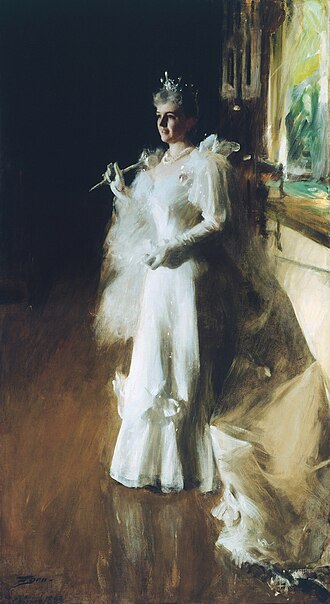
Portrait titled Mrs. Potter Palmer by Anders Zorn, 1893
Palmer interacted extensively with Harriet Hosmer—the famed neoclassical sculptor who lived openly in a same-sex partnership in Rome within an expatriate circle of independent women sculptors (often referred to historically as the "white marmorean flock").
Sara Tyson Hallowell was Palmer's primary art advisor who introduced her to European Impressionism. Hallowell lived in same-sex cohabitation setups in Paris and navigated the queer-adjacent expatriate women’s art scene of late 19th-century Europe.
Palmer personally commissioned Mary Cassatt to paint the central Modern Woman mural for the Woman’s Building. Cassatt spent her life as an independent unmarried artist in Paris, operating within homosocial artistic networks.
The 1893 Woman’s Building championed by Palmer established a historic precedent for autonomous, female-governed cultural spaces.
Influence on the 1970s Lesbian & Feminist Movements: Art historians and queer scholars (such as those documenting the 1970s Feminist and Lesbian Art Projects) highlight Palmer’s 1893 Woman's Building as an early structural predecessor to the Los Angeles Woman's Building (founded in 1973 by Judy Chicago, Arlene Raven, and Sheila de Bretteville), which served as a major hub for lesbian feminist art, performance, and education.
References:
Support this project
This website is a passion project researched, developed, and funded entirely by me. If you find the content valuable and would like to help support the ongoing research and hosting costs, any contribution is deeply appreciated.
Thank you for keeping this independent resource alive!
My books on Amazon: Elisa Rolle's books